
Architecture
Baumbart is a LangGraph-driven chatbot runtime that delegates structured question answering to a Qanary pipeline and reads the resulting annotations and answers from a triplestore.
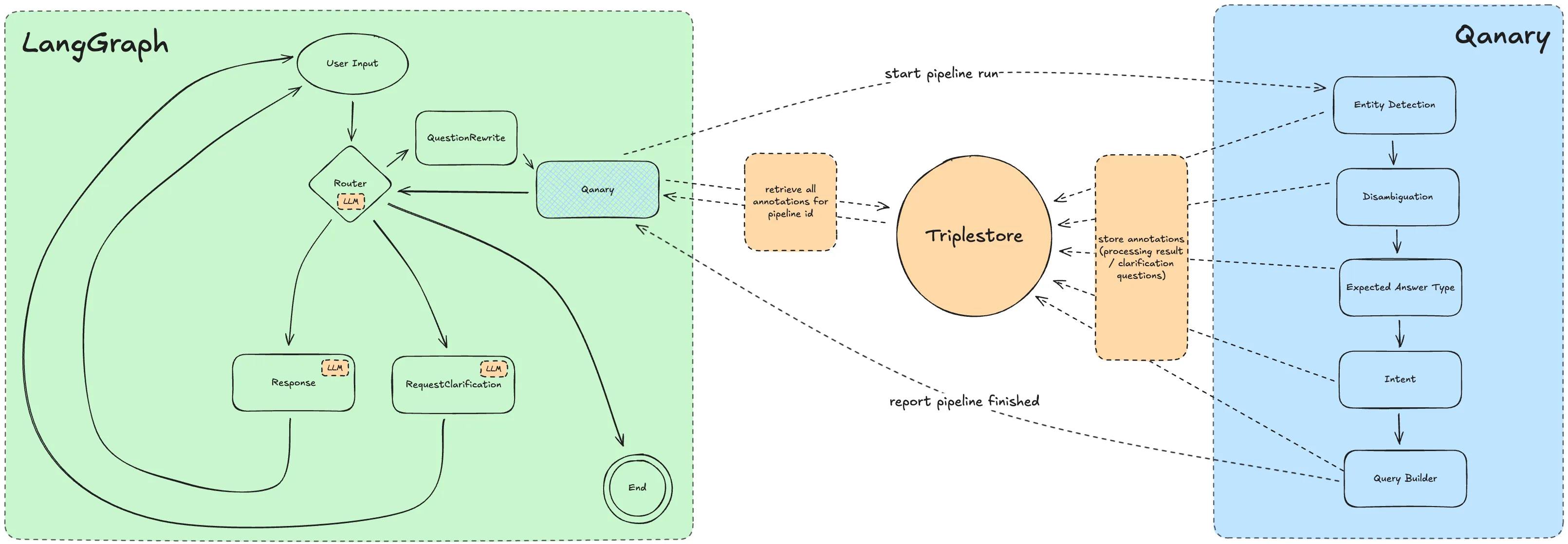
The diagram is a simplified map of the system. The current implementation is defined by the package boundaries, graph nodes, and integration flows described below.
Main Building Blocks
Section titled “Main Building Blocks”apps/chatuiis the web entrypoint. It restores or creates a chat session, exposes the initial message history, and runs the websocket boundary used for live chat messages and metadata updates.packages/chatbotcontains the conversation engine. It builds the LangGraph state machine, tracks the agent state, emits progress metadata, rewrites questions, and decides whether the next step is answer generation or a clarification question.- The Qanary components implement the structured question-answering pipeline. In the current setup they classify the expected answer type, extract entities, disambiguate matches, detect the relation, and generate a SPARQL query.
- The triplestore is the shared storage boundary between the Qanary pipeline and the chatbot runtime. Qanary writes annotations into a named graph, and the chatbot later reads the final answer and clarification annotations back from that graph.
- The LLM layer is used around the structured pipeline, not instead of it. It rewrites follow-up questions, phrases clarification prompts, and turns the structured Qanary result into a natural-language answer.
Conversation Flow
Section titled “Conversation Flow”apps/chatuiloads or creates an in-memory session state and opens the websocket connection used for the conversation.packages/chatbotstarts the LangGraph runtime from the current agent state and waits for the next user input.- The router evaluates the current
chatmodeand sends new user questions into the question-answering path. - The question rewrite node consolidates the existing conversation history and the latest user input into one self-contained question.
- The Qanary orchestrator calls the Qanary API with a fixed component list: expected answer type, named entity recognition, disambiguation, relation detection, and SPARQL generation.
- The Qanary pipeline writes its annotations and answer data into a named graph in the triplestore.
- The chatbot runtime reads the final answer annotation and any clarification annotations from that graph.
- The router either sends the conversation to clarification generation or to final response generation, then returns to waiting for the next user input.
Clarification Loop
Section titled “Clarification Loop”Baumbart models the conversation with three high-level chat modes:
USER_QUESTIONcollects a new user request.RESPONSEmeans the system is preparing or delivering a response.CLARIFICATIONmeans the system has open clarification questions backed by Qanary annotations.
When the chatbot reads clarification annotations from the triplestore, it
builds a clarification conversation and switches into CLARIFICATION.
RequestClarificationNode asks the next open clarification question using the
LLM layer, while UserInputNode stores the answer against the current
clarification item.
Once all clarification questions have been answered, the router switches back to the question-answering path. The question rewrite node then reissues the enriched user request so the Qanary pipeline can run again with the new context.
Qanary Pipeline
Section titled “Qanary Pipeline”The chatbot currently invokes Qanary with a fixed component order:
- Expected answer type
- Named entity recognition
- Disambiguation
- Relation detection
- SPARQL generation
This sequence produces the annotations that later drive response generation and clarification handling.
Data and Integration Boundaries
Section titled “Data and Integration Boundaries”- Websocket traffic between
apps/chatuiand the chatbot runtime carries both chat messages and metadata events such asWAITING_FOR_INPUT,GATHERING_DATA, andGENERATING_RESPONSE. - Chatbot state is stored in memory per session in the current implementation. Session IDs are cookie-backed, but the actual state lives in a process-local map inside the chat UI server.
- The chatbot does not receive the final end-user answer directly from Qanary. The Qanary API returns a graph URI, which the chatbot then uses to read the relevant annotations from the triplestore.
- The triplestore is the main handoff boundary between the chatbot and the Qanary pipeline. It stores both final answer annotations and clarification annotations for the current question graph.
- OpenRouter-backed LLM calls are used only for question rewriting, clarification phrasing, and final answer phrasing around the structured data returned by Qanary.
These boundaries are the main integration points contributors need to understand when changing runtime behavior.
Current Constraints
Section titled “Current Constraints”- Chat session state is process-local and in-memory, so it is not shared across multiple server instances and does not survive a process restart.
- The list of Qanary components is fixed in
packages/chatbotrather than being configured dynamically per request. - Qanary API access, triplestore access, and LLM access are runtime dependencies provided through environment configuration.